
Legal Services Commissioner v JDG [2008] LPT 17 is a shocking case in which a Queensland barrister was struck off after he lied when confronted by investigators with the true proposition that he had offered to pay a $50,000 bribe to a Magistrate or Crown prosecutor on behalf of a client. He also took $59,000 in cash from the direct access client and popped it into his safe. He used some of it to feed his gambling. He should, of course, have chucked it into a special account. He told his client that: Continue reading “Beak bribe boast bars barro”
Nettle JA on sentencing thieving lawyers
R v Maurice B [2008] VSC 254 records the sentencing remarks of Nettle JA apparently sitting in the trial division following a guilty plea by a solicitor who stole a quarter of a million dollars. The solicitor argued the state of his mind was relevant in two ways. First, he said his impaired mental functioning short of psychiatric illness at the time of the offending diminished his moral culpability. Secondly, what appears to have degenerated into a psychiatric illness (depression, anxiety disorder, panic attacks requiring anti-depressants) was a relevant consideration in determining an appropriate sentence.
Based on the psychiatric evidence, Justice of Appeal Nettle gave little truck indeed to the first claim, but did take the mental state of the solicitor by the time he had been through the Legal Profession Tribunal and the criminal charges into account in fashioning an appropriate sentence. In fact, along with the solicitor’s age (67) his mental condition at the time of sentencing was the thing which kept him out of the clink. His Honour conducted a survey of a number of Victorian cases involving thieving solicitors who received suspended sentences of imprisonment and remarked:
‘I doubt that the sentences imposed in at least some of those cases gave due weight to the overriding importance of general deterrence in matters of this kind. For, even allowing that a suspended sentence is a sentence of imprisonment for all purposes, it is manifestly less burdensome than an immediate term of imprisonment. It is also to be remembered that the maximum sentence for the offence of having a deficiency in a trust account has more than doubled since the Legal Professional Practice Act 1958 was first replaced by the Legal Practice Act 1996, from seven years to 15 years’ imprisonment. These days, the idea of a fully suspended sentence in a case of solicitor defalcation will seldom sit easily with the imperative that solicitors who act in fraudulent breach of trust account obligations “must … inevitably suffer severe punishment”.’
The whole of the relevant passage is: Continue reading “Nettle JA on sentencing thieving lawyers”
Ode to Dunalley
I took a holiday in Dunnalley, on the way from Hobart to Port Arthur, just 3 days after the Legal Profession Act, 2007 (Tas) finally came into operation on New Year’s Eve (more at the end of the post). Dunalley’s my kind of place: a tiny fishing village full of geraniums, a few remaining fishing boats, a waterfront cafe cum second hand store, a spectacular beach, a general store with a large collection of hunting magazines, a considerably above average (but not quite excellent) bakery, a post office with a keen cottage gardener at the helm, a superficially picturesque pub, a couple of beautifully situated and almost untouristed wineries, rural drives through countryside akin to my 7 year old imagination of The County when reading Tolkien punctuated by little roadside stalls selling cherries and raspberries worthy of interstate travel, many magpies, and a 40 minute drive from Hobart (and the Jackman + McRoss bakery in particular) and more or less entirely unknown to Google.
But it is the Dunalley Fish Market which made me fall in love with the place, in this era when buying fresh fish caught by fishermen in fishing villages seems inexplicably difficult. Every day or so, I got into our sardine can-like hire car and drove to the end of the road to the ramshackle place which is perched on the side of the bay, and purchased some fresh fish, or a $4 tub of ‘fish pate’, or some smoked octopus, or some excellent fish and chips, or shucked as you wait oysters, or lobsters — live or freshly cooked. One enchantingly laconic individual who commutes from Hobart runs the place. Presumably it is his Elvis posters which interrupt the otherwise marine decor.
If all that appeals to you, go stay at my mate’s inlaws’ quiet and beautiful place, Potter’s Croft, and have my mate Gus and his wife Vanessa take you on one of their incredible guided tours of a giant private property called Bangor with 35 km of spectacular coastline which has been in the same family since white settlement. Continue reading “Ode to Dunalley”
Tendency evidence in solicitor’s negligence case
Vaccaro v Flammia [2008] NSWSC 1322 is a tantalizing case about the admissibility of tendency evidence of dishonesty against a solicitor and about issue estoppel arising from earlier cases brought by others against the same solicitor. It was decided against the uniform evidence legislation which has been introduced into Victoria by the Evidence Act, 2008 (Vic.), yet to commence. The tantalization which is an incident of this being only an interlocutory decision will be consummated if the matter goes to trial.
The solicitor’s clients left a certificate of title with him for safekeeping. He kept it in ‘a tin’ in the back room of his practice. Someone took it without the clients’ authorization and raised $400,000 by forging their signatures on a mortgage. The clients did not receive any of the money. The witness which the mortgage instrument suggested had witnessed it did not exist. Continue reading “Tendency evidence in solicitor’s negligence case”
Reasons
It is very frustrating when you receive a judgment which skates over the points you think were good ones without grappling with them. Turns out it is an appellable error of law. The guy who won half a million dollars for assault by Connex officers after he spat in their face and broke his wrist as he fled got rolled on appeal, though he lives to fight another day in a retrial: ACN 087 528 774 P/L v Chetcuti [2008] VSCA 274. The trial judge’s reasons were inadequate, according to Acting Justice of Appeal Hargrave, with whom Justices of Appeal Ashley and Dodds-Streeton agreed. His Honour said: Continue reading “Reasons”
Dentist does worse on appeal to VCAT than before the Dental Practice Board
In Von S v Dental Practice Board [2008] VCAT 2302, a dentist sought merits review in VCAT of a decision of the Dental Practice Board to suspend his registration for 3 months. He had practised for two and a half months without being registered (a crime punishable by a maximum fine of $11,000), practised without insurance for 20 months, and been uncooperative when the Board sought to investigate him by failing to respond to letters, and then breaking a promise to see a psychologist and provide a report. Continue reading “Dentist does worse on appeal to VCAT than before the Dental Practice Board”
Unrepresented David’s bank obliteration results in judicial call for ‘The Castle’ sequel
I staved off a bank’s applications for summary judgment for possession last year, and maintain the battle. I will not say victory flowed from my argument that the evidence which purported to establish the incorporation of one of Australia’s largest banks was inadmissible, but I did make that argument, and a perfectly valid one it was too, though had it been necessary no doubt it could have been cured by an adjournment. I do not think it endeared me to the Supreme Court. But as this case shows, you can’t assume anything.
Justice Kenneth Crispin is obviously a man with a sense of humour. He retired last year, and his farewell speech is worth a read. The quiet humour, though, is to be found in his Honour’s recitation of the dogged victory of pro se litigants Stanley Stergiou and his wife Ekaterine in Stergiou v Citibank Savings Ltd [2005] ACTCA 15. A Greek migrant, Mr Stergiou was in his 70s at the time of victory. If the story does not warm the cockles of your heart then you are an un-Australian curmudgeon. The judgment of the President of the ACT Court of Appeal began: Continue reading “Unrepresented David’s bank obliteration results in judicial call for ‘The Castle’ sequel”
Negligence claim against solicitor is a relevant factor in a limitation period extension application
Personal injuries guru recently turned Supreme Court judge, Justice Forrest, declined an application for an extension of time in which to bring an action for negligence against a cruise line. The case was Gordon v Norwegian Capricorn Line (Australia) Pty Ltd [2007] VSC 517. His Honour said the case against the cruise line was a simple, one issue case. Had the extension application succeeded, the trial would have taken place nine years after the allegedly negligent treatment of a heart attack suffered by the plaintiff at sea. The representation of the plaintiff by his former solicitors S&G Ltd was characterised by ‘ineptitude’, the judge found.
A key reason for declining the extension was the availability of a reasonably simple cause of action for negligence against the plaintiff’s former solicitors. Justice Forrest had more material against which to judge the prospects of success in such a claim than in other cases, where the signficance of the availability of a negligence claim against the applicants’ former solicitors was downplayed. His Honour had enough to conclude that the plaintiff had a ‘powerful if not overwhelming case’ against S&G Ltd (I can feel a settlement coming on…). His Honour set out the law in relation to the relevance of an extension of time application of the availability of a professional negligence claim against a solicitor as follows: Continue reading “Negligence claim against solicitor is a relevant factor in a limitation period extension application”
Ian Enright’s Professional Indemnity Insurance Law
I have a bad habit of buying books which cost several hundred dollars each and get overtaken by new editions after a couple of years. I am yet to experience the pain of an expensive text I have bought going into a new edition though, so nascent is my career as a barrister. About this time last year, I had lunch with a judge of the Supreme Court who told me to my absolute astonishment that at the height of his career at the Bar, he spent $80,000 a year on books and reports. That news did me no good at all.
Texts are good, a basic fact of legal life which young lawyers are rapidly overlooking. Without text writers, the law could not possibly survive in its current form. They have an important function. They ignore the bad decisions and explain what the long ones mean.
I picked up most of the library of John de Konig when he retired in June. So I’m seriously well stocked for insurance texts — Sutton’s Insurance Law in Australia, Derrington’s Liability Insurance Law, Kelly & Ball’s Principles of Insurance Law, Mann’s Annotated Insurance Contracts Act, Tarr’s Australian Insurance Law, Clarke’s The Law of Insurance Contracts, Ivamy’s General Principles of Insurance Law, and even Mitchell’s The Law of Subrogation (feel free to come and borrow them).
Recently I picked up a serious text: Ian Enright and Digby Jess’s Anglo-Australian Professional Indemnity Insurance Law, Second Edition, December 2007. It has a green faux leather hard cover with gold lettering. Published by Thomson, it’s almost 1,000 pages long, and retails at $541. It’s a monumental work, the only one devoted exclusively to its subject, and it naturally won the 2008 British Insurance Law Association prize for the most notable contribution to the literature of insurance law for the year. It’s a good book because it achieves one of Enright’s aims, which was to start each topic at the start so as to make it accessible to the non-specialist reader. It is well-organised, and carefully cross-referenced. And it contains lots of answers, which is handy because that’s what I’m in the business of selling. Continue reading “Ian Enright’s Professional Indemnity Insurance Law”
Special responsibilities of lawyers as litigants
Lawyers are the only litigants who are entitled to recover from the counterparty in litigation costs for representing themselves: Guss v Veenhuizen (No 2) (1976) 136 CLR 47. Suing the client for fees can therefore be a nice little earner for lawyers. There is a species of lawyer whose suits for fees are conducted in an ugly fashion, particularly where the former client is unrepresented. I do not like it when I see cases where solicitors have issued chambers summonses without notice to strike out incompetently prepared handwritten defences, obtained costs of their own appearance, and then issued a summons for oral examination when the costs go unpaid. No doubt this kind of abuse explains why there are limits on the entitlement to sue for fees, such as the obligation to wait 65 days after giving the bill: s. 3.4.33(1), Legal Profession Act, 2004.
If ever you need authority to throw at a lawyer who seems to be using the processes of the Court in an over-enthusiastic manner, check out Circuit Finance v Gardner [2006] VSC 70 (which was not a case about a suit for fees). Continue reading “Special responsibilities of lawyers as litigants”
Solicitor gets three year break for multiple conflict findings
In Legal Services Commissioner v DJMH [2008] VCAT 2301, Deputy President McNamara’s tribunal ordered the solicitor not to practice before 1 July 2011 for multiple findings of acting in the face of a conflict. It is unfortunate that the reasons for decision do not allow an understanding of what was alleged. It had something to do with conflicts of duties in lending transactions described as ‘very serious indeed’. The gravamen of the charges, according to the Deputy President was that the solicitor: Continue reading “Solicitor gets three year break for multiple conflict findings”
The lien and the solicitor who finds himself practising certificateless
Update: More solicitors’ lien cases: Magnamain Investments Pty Ltd v Baker Johnson Lawyers [2008] QSC 245, and Stark v Dennett [2007] QSC 171, a case about who should be taken to have terminated the retainer and which sets out the law thoroughly.
Original post: As I have already noted in these pages, Issac B was given a holiday by VCAT, and told not to apply for a work ticket until next year. Since then, things have got considerably worse for the iconoclast, but more about that in a little while. Cosgriff v Issac B & Co [2008] VSC 515 reveals that Issac B & Co’s practice was ‘transferred to a multi-disciplinary practice in which Malcolm Buxton is the principal legal practitioner.’ Naturally, you can’t sell your clients. If they don’t want any truck with the new owner of the business, it’s tough titties for the new guy. So it was here: Issac’s former client went off and retained Slater & Gordon.
The question decided by Justice Byrne was whether the solicitor could maintain a lien in circumstances where his retainer had come to an end by virtue of his inability to practise. (As an aside, it is interesting that this is yet another decision of a case about a matter directly governed by the solicitors’ conduct rules, where the Court does not even mention them, as is also often the case in applications to enjoin solicitors from acting in the face of a conflict of duties.) The decision was that Issac B could not assert the lien, because he was taken to have terminated the retainer: Continue reading “The lien and the solicitor who finds himself practising certificateless”
Conduct in litigation as an aid to assessing party witnesses’ credibility
In Westmelton (Vic) Pty Ltd v Archer & Schulman [1982] VR 305, Starke, Kaye and Fullagar JJ commented on the trial judge’s finding that the evidence of a solicitor Archer should be preferred over that of one of Westmelton (Vic) Pty Ltd’s directors, because the director had avoided service of a subpoena. His Honour had said:
‘I have also to bear in mind that he … avoided service of a subpoena and came to Court only after I had given leave to effect substituted service on his wife.’
The appeal judges said:
‘Although his Honour saw and heard the witnesses, we were not referred to anything in the circumstances or in the evidence which would justify him drawing an inference adverse to the credit of [the director], or adverse to [Westmelton], merely from the fact that he, being a busy Sydney director for a large Sydney-based corporation, wished to escape if he could from the necessity of giving evidence from some time before the Supreme Court in Melbourne.’
But there are times when a party’s conduct in litigation will be taken into account in assessing their credibility as a witness. Back to one of my favourite judgments of recent times, Justice Bill Gillard’s Medibonk judgment in Li v Herald & Weekly Times Pty Ltd [2007] VSC 109 (see this earlier post). His Honour said:
‘300 I am satisfied that Ms Li lied in respect to a number of material issues and she lied because she knew that if she told the truth it would be established, first, that she was conducting an illegal brothel, secondly, that she was providing sexual services for money, thirdly, that she was a prostitute in the sense of charging for sexual services, and fourthly, that she had signed and issued false receipts to enable her patients to make an application for a refund from a private medical insurer. I am satisfied the false denials provide cogent evidence supporting the defence of justification that Ms Li was providing sexual services for clients and issuing them with false receipts to enable them to recover a refund from their private insurers.301 My conclusion is reinforced by Ms Li’s conduct and that of her lawyers in respect to the institution of this proceeding and during the following ten months, which leads to the conclusion that she, and her legal team, had little faith in her own personal claim. Continue reading “Conduct in litigation as an aid to assessing party witnesses’ credibility”
Professional misconduct seminar
The Law Institute is presenting a seminar on professional misconduct on Thursday evening from 5.30 p.m. A reserve tickets are selling for the bargain price of just $175. The blurb says:
‘Kim [Lovegrove, a solicitor] and Sav [Korica, a barrister] will discuss the wider implications of the ways in which professional misconduct is dealt with in many disparate professions, and how many tribunals and disciplinary bodies have come to resemble each other in their methodology.’
Is the draft witness statement held by the witness privileged?
Justice Finkelstein’s decision in Australian Securities and Investments Commission v Mining Projects Group Limited [2007] FCA 1620 has provided material for the last 2 posts. Now, a third. His Honour had to consider a question I have never been too sure about. Say there is a case on foot, but it’s long before trial. A solicitor for one of the parties interviews a witness. The witness says his thing. The solicitor turns it into a witness statement. The solicitor sends the witness a copy. There is no doubt that the original witness statement drafted by and retained by the solicitor is privileged under the litigation limb of legal professional privilege. But what about the copy held by the witness?
Well, though it’s clearly privileged under the uniform evidence legislation, there’s conflicting authority in relation to the position at common law. The two most recent appellate authorities say the witness statement and the copy witness statement are both privileged. On the other hand, Chief Justice French plumped for the opposite conclusion while on the Federal Court. Even if it is privileged, that cannot mean that the witness cannot say the whole thing over again to anyone else who may care to enquire, because there is ‘no property in a witness’. And I do not suppose the witness would have any positive obligation to assert the solicitor’s client’s privilege (anyone disagree?). But depending on the cirucmstances, the witness may owe an obligation of confidentiality to the solicitor’s client which would give rise to equitable rights in the solicitor’s client if the witness gave up the witness statement. Of course compulsion, such as an obligation of discovery under rules of court, properly administered interrogatories, a regulator exercising a statutory power, and a subpoena trump mere confidentiality. It may be that in the face of compulsion, only if the solicitor’s client stepped in and asserted his or her privilege over the documents would the compulsion not result in delivery up of the witness statement. Justice Finkelstein’s learned analysis went like this: Continue reading “Is the draft witness statement held by the witness privileged?”
Da Fink reckons the Bureau should act with the fairness of Crown prosecutors
In Australian Securities and Investments Commission v Mining Projects Group Limited [2007] FCA 1620, Justice Ray Finkelstein, aka da Fink, sowed a seed for future courts to take up and declare that regulatory authorities bringing civil penalty proceedings should have the same duties as criminal prosecutors. Having cited the authority to say that they do not, his Honour said:
’35 A lay person might be forgiven for thinking that in the present context the distinction between civil and criminal proceedings is somewhat artificial and that in both kinds of proceedings the regulatory authority or prosecutor (as the case may be) is under a duty to ensure that the decider of facts (judge or jury) is best placed to arrive at the proper and just result.’
Then, with the judicial equivalent of biting sarcasm:
‘Perhaps the reason courts have rejected this approach is that in a criminal proceeding a conviction may result in imprisonment whereas in a civil penalty proceeding the worst that can happen is that the defendant’s career is ruined or his life is wrecked.’
Continue reading “Da Fink reckons the Bureau should act with the fairness of Crown prosecutors”
VCAT reversed for ignoring penalty privilege in merits review of disciplinary proceeding
CT v Medical Practitioners Board [2008] VSCA 157 is a very important ruling for the world of professional discipline, and its intersection with the world of VCAT. A doctor sought merits review of a disciplinary decision of the Board. The Court of Appeal made clear that the penalty privilege (a close relation of the privilege against self-incrimination), when applied to disciplinary hearings where a penalty such as a fine or a suspension from practice may be imposed (including rehearings such as merits reviews in VCAT), means that VCAT ought not give directions which:
‘require the applicant for review to provide an outline of argument, or any other written material, which contains a positive assertion or denial of facts or requires an election by the applicant as to whether he or she intends to go into evidence or requires any proposed evidence the applicant intends to call to be the subject of a witness statement which must be produced and served on the other side, before the case advanced against the applicant has been completed.’ Continue reading “VCAT reversed for ignoring penalty privilege in merits review of disciplinary proceeding”
Solicitors as agents
The Bell Group litigation was a big one. Richard Ackland reports on Justice Owen’s attempts to make more enjoyable the process of writing judgment in a matter the trial of which went for 400 days over 3 years. You will be relieved to know that I have not read The Bell Group Ltd (in liq) v Westpac Banking Corporation (No 9) [2008] WASC 239. But I did have a look at it. The penultimate paragraph (no. 9761) reads:
‘From time to time during the last five years I felt as if I were confined to an oubliette. There were occasions on which I thought the task of completing this case might be sempiternal. Fortunately, I have not yet been called upon to confront the infinite and, better still, a nepenthe beckons. Part of the nepenthe (which may even bear that name) is likely to involve a yeast-based substance. It will most certainly involve a complete avoidance of making decisions and writing judgments.’
(I am interested to know what others think “(which may even bear that name)” means. There is certainly a winery named Nepenthe, but it seemed more likely to me that the drug of forgetting Justice Owen had in mind was in fact Westralian beer — perhaps Little Creatures as an antidote to the behemoth that was this case.)
But blow me down if there isn’t something of interest to this blog: an analysis of the solicitor qua agent of the client, and the imputation of knowledge from the one to the other. I’m sure the time will come soon enough when I will be glad of Justice Owen’s industry, and pleased with myself for squirrelling this passage away. Here goes: Continue reading “Solicitors as agents”
Blackstone

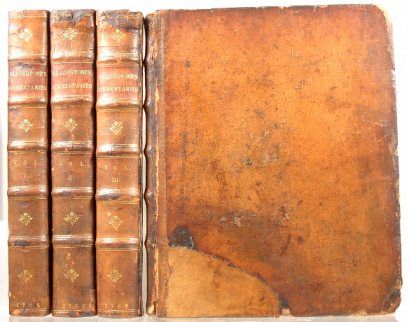
My memory of Enid Campbell’s lectures on William Blackstone was a bit hazy, so David Pannick’s article about him in The Times (‘A sour, morose and imperious judge of the common law’) was welcome. Until I pulled this picture off Wikipedia, I had no idea the famous author was in fact a hare. He was the first Vinerian Professor of Law at Oxford. He wrote down the whole of the English common law in his Commentaries on the Laws of England (you can have the pictured copy for US$15,000), back in the days when serious moollah was to be had for doing such things (he netted £14,000, which equates to about £1.5 million according to this calculator based on the retail price index). Volume 1 was published in 1765, when Bach was not long dead, Mozart was 9, Captain Cook had not set sail for Australia, and the first restaurant had just opened in Paris. The average Australian lawyer’s most frequent intercourse with Blackstone is probably the Mabo decision, in which the common law’s view about ‘desert and uncultivated’ colonies featured. This is the passage:
Anti-establishment propaganda enjoyed within highest office
(Songs about trials, part 2) If I told you the precise location within the third great arm of government of the individual who nominated Pink Floyd’s ‘The Trial’, a segment from the filmic rock opera The Wall, you wouldn’t believe me. More of his rich collection of songs about trials to come.
You wouldn’t know it from the comments but there is quite a flutter as various music buffs email me their lists, and then email me begging to know what others have enumerated. This is just the beginnings, peoples. All will be revealed in time.
httpv://au.youtube.com/watch?v=FCMHmDnfD6I
An extract from the lyrics: Continue reading “Anti-establishment propaganda enjoyed within highest office”